A Translation Project
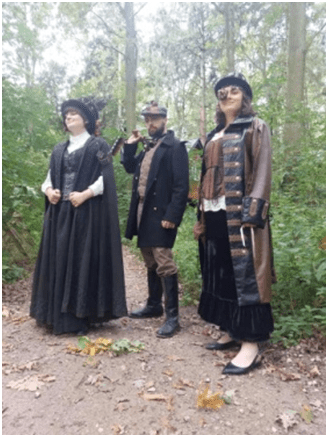
Hello, I’m Corentin! French guy, 28 years old and maybe a writer one day. I am with Elfie and Vittoria on this wonderful journey.
Our team was recruited to carry out a European Solidarity Corps at the Middelaldercentret, a medieval living-history museum. And not a day goes by without us being extremely greatful for ou luck !
But what is a European Solidarity Corps exactly ? In short, an ESC offers young people who wants to help, learn and grow the opportunity to have a positive and inspiring experience, most often abroad. This is a volunteer service that can last from two weeks to a year. It’s a great experience to live. If you are under 30 years old, we can only recommend that you give it a go !
The association that received us here and helped us with our installation is called AFS. A bit of History : In 1914, as World War One broke out, young American students chose to volunteer to rescue the wounded on the battlefield : the American Field Service was born. After World War Two, AFS became a major exchange program for students and high school students between France and the United States.
Today AFS works to bring cultures together through its international educational and intercultural exchange programs in more than 50 countries.
Their employees are warm and always attentive. With them, there is no impossible problem to solve.
But what does this famous museum look like?

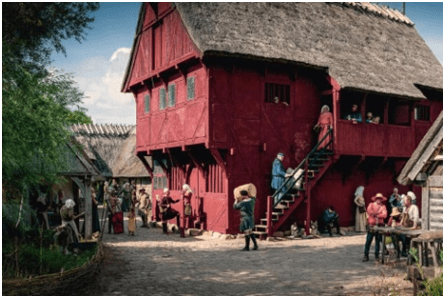
These two photos briefly show the Middelaldercentret which is located on the Lolland-Falster island in Denmark.
It is an intercultural environment where we learn every day the ways of craft things the way our ancestors did and recreate for visitors the atmosphere that may have reigned at that time. All the workers are wonderfull.
We contribute as mediators, opening houses (in which people can actually sleep !) in the morning, teaching people to shoot with a long bow, helping the shooting with reconstructed trebuchet and cannons, setting up the horses and the arena for the tournament and actively participate in it as squires or helper at the centre court, and we are also developing our own creative handcrafts projects…
To do this, each of us has been assigned a mentor. Personally, I became a blacksmith’s assistant !
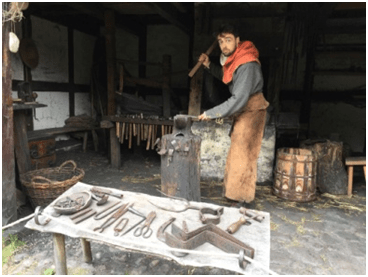
What is it like to work like in the Middle ages ?
It’s physical, but hard work does not scare me. What amazed me the most was that the techniques aren’t that hard to learn. Well, for the most part. It only takes a few hours, or even a few days, to assimilate one. But above all, it takes a long time to finish even the smallest object ! Unless, if like my mentor you have a lot of knowledge and experience. In which case, it is done so fast that it looks like magic !
During our stay, we also set up a small solidarity project.
*
Exemple of a french translation :
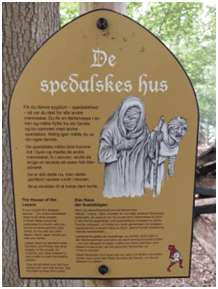
Si vous attrapiez cette maladie, la lèpre, vous étiez considéré mort par tout le monde. Une Messe des Morts serait célébrée à l’église, et vous seriez séparé de votre famille afin de vivre avec les autres lépreux. Vous ne reverriez jamais vos proches.
Les lépreux n’étaient pas autorisés à entrer dans la ville et s’ils rencontraient d’autres personnes, dans les bois par exemple, vous deviez utiliser un hochet pour prévenir les personnes saines de votre affliction.
Ils sont tous morts désormais, mais leurs fantômes errent toujours dans les vois. Utilisez un hochet pour les éloigner.
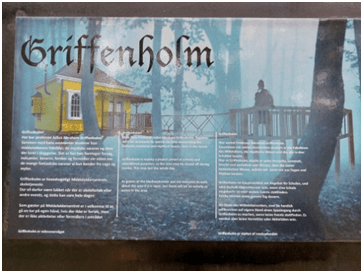
Le professeur Julius Abraham Griffenholm vit ici. Avec ses assistants, il étudie les créatures fabuleuses du Moyen Âge, les créatures mystérieuses et celles qui se cachent dans l’ombre. C’est là qu’il mène des expériences, collecte, préserve, recherche et diffuse ses connaissances sur les nombreuses créatures fantastiques que nous ne connaissons que par les légendes et les mythes.
Griffenholm est principalement un projet destiné aux écoles et à but éducatif, donc la zone peut être fermée à l’occasion d’événements. Cela peut durer toute la journée.
En temps que visiteurs du centre médiéval, vous pouvez vous promener dans la zone si elle est ouverte, mais il n’y aura ni activité ni acteurs.
*
Our first idea was to translate the museum’s website into Italian (for Vittoria) and French (for Elfie and myself). The museum already has translations into German and English. But it would help visitors from others countries if they had the possibility to choose between more languages. Fortunately, we had been in the field this year to explain to foreign families exactly what was going on.
We would like to extend that project.
The photos you can see show signs placed in the green heart of the Middelaldercentre: the Magic Forest.. This “enchanted” walk introduces certain Scandinavian myths. We have decided to translate them.
Likewise, during the tournament and the trebuchet shooting, a mediator is commenting what’s going on and explaining the many challenges that the two knights have to accomplish. For obvious reasons, he will only speak Danish, sometimes with English if the occasion calls for it. We have also translated these passages.
But how do you offer them to visitors ? This is where technology comes in.
*

Le dragon est une créature à écailles, reptilienne, le plus souvent à quatre pattes. Il a un goût particulier pour les églises, autour desquelles il aime s’enrouler pour se reposer. Quand un dragon dort sur de l’or, le trésor double par magie au cours de la nuit. Les dragons peuvent généralement parler, on les dit très rusés, mais aussi très malveillants.
Seul le plus valeureux des héros peut vaincre un dragon, comme le fameux Siegfried le pourfendeur de dragons, l’archange Michael, et bien sûr Saint George. Le sang du dragon est tellement vénéneux qu’une seule goutte sur la peau suffit à ôter la vie. Néanmoins, le sang de son cœur a des pouvoirs magiques et donne des pouvoirs spéciaux : Là où le sang a touché votre peau, vous devenez invulnérable, et si votre langue touche le sang, vous pourrez comprendre le langage de tous les animaux.
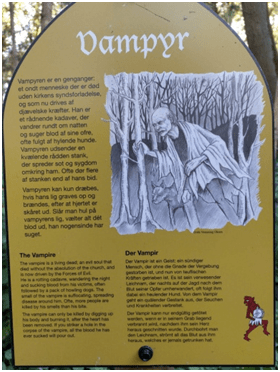
Le vampire est un mort vivant ; une âme malveillante qui est morte sans l’absolution de l’Église et qui est désormais mue par les forces du Mal.
C’est un cadavre en décomposition, errant la nuit et suçant le sang de ses victimes, souvent suivi d’une horde de chiens hurlant. L’odeur du vampire est suffocante et répands des maladies autour de lui. Souvent, les gens meurent de cette puanteur plutôt que de sa morsure.
Le vampire peut seulement être tué en creusant pour retrouver son corps et le brûler, après que le cœur en ait été retiré. Si vous faites un trou dans le corps du vampire, tout le sang qu’il a sucé s’en échappera.
*
With the help of a QR code, visitors can easily find all this information. This code will be available at the entrance in order to avoid hanging modern signs all over the museum and thus preserving both nature (by limiting paper waste) and the immersive experience in the past. In addition, it will allow the inclusion of people with disabilities, for example.
One of the biggest advantage to me is that after our scheduled departure at the end of October (for me at least) the museum staff will be able to continue using this new service, developing it so that it fit all their needs. Maybe other volunteers after us will work on it too. It will form a kind of chain. A chain of will and mutual aid which I hope will last for a long time.
That’s it for the three of us. I hope this has made you want to hire yourself, or at least visit this museum as well as Denmark. If you take this step, try especially their delicious pastry !
Vi ses !
Vittoria, Elfie, Corentin.
 ESC Solidarity Projects